Home Physics Electromagnetic Induction Mix A plane loop is shaped in the form as shown …
Physics Electromagnetic Induction Mix Subjective Type
Published on: September 12, 2026

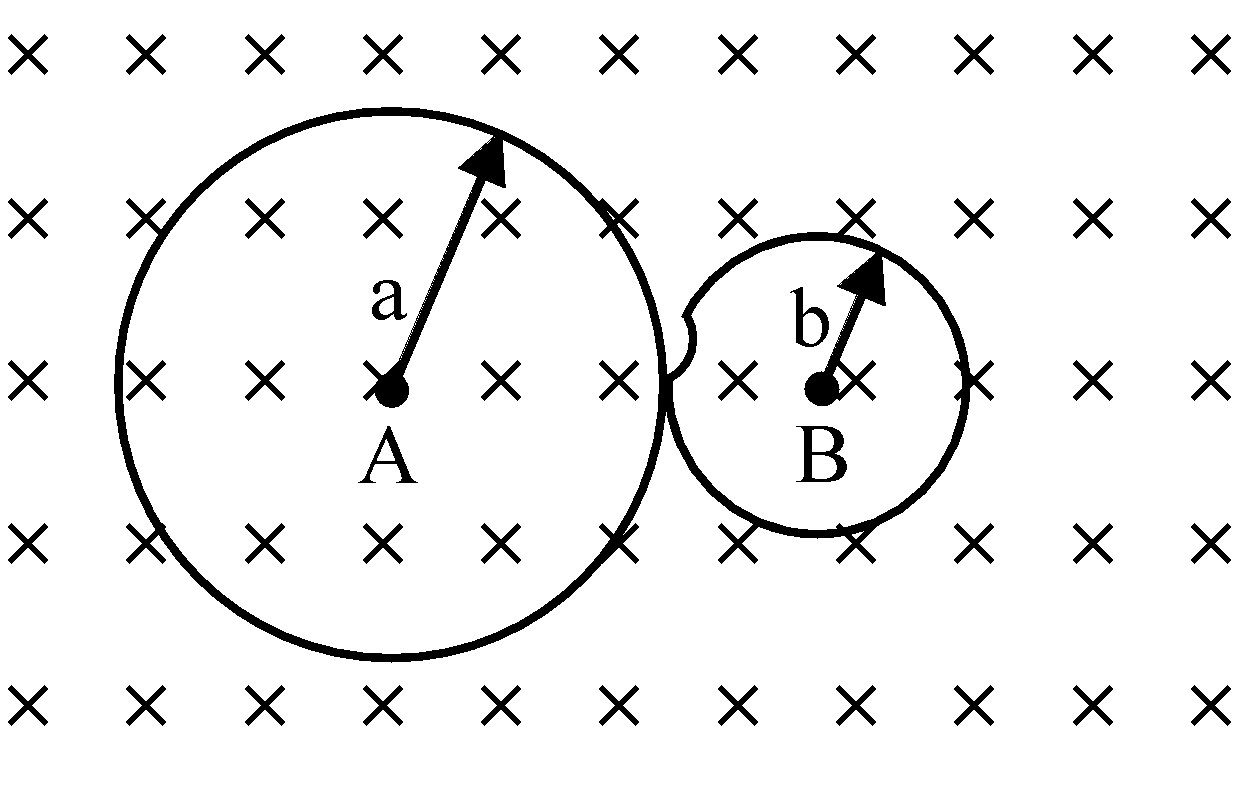
A plane loop is shaped in the form as shown in Fig. with radii a = 20 cm and b = 10 cm and is placed in a uniform time varying magnetic field B = B 0 sin ω t where B 0 = 10 mT and ω = 100 rad/s. Find the amplitude for the current induced in the loop if its resistance per unit length is equal to 50 × 10 –3 Ω /m. The inductance of the loop is negligible.
Share this question

For Instagram sharing, use “Apps” on mobile or copy the link.

Text Solution

Verified by Experts
The correct answer is:
A
To determine the amplitude of the induced current in the loop, we start by calculating the magnetic flux through the loop and then use Faraday's law of electromagnetic induction.

**Step 1: Calculate the area of the loop.**
The loop consists of two circular arcs with inner radius (b) = 10 cm = 0.1 m and outer radius (a) = 20 cm = 0.2 m. The cross-sectional area of the loop can be approximated as the area of the outer circle minus the area of the inner circle:
\[ \text{Area} (A) = \pi a^2 - \pi b^2 = \pi (0.2^2) - \pi (0.1^2) = \pi (0.04 - 0.01) = \pi (0.03) = 0.09424778 \, m^2 \]

**Step 2: Find the magnetic flux (Φ) through the loop.**
The magnetic field is given as \( B(t) = B_0 \sin(\omega t) \), where \( B_0 = 10 \, mT = 0.01 \, T \) and \( \omega = 100 \, rad/s \). The magnetic flux is given by:
\[ \Phi = B(t) \cdot A = 0.01 \sin(100t) \cdot 0.09424778 \, m^2 \]
\[ \Phi = 0.0009424778 \sin(100t) \, Wb \]

**Step 3: Calculate the induced EMF (ε).**
According to Faraday's law:
\[ \varepsilon = -\frac{d\Phi}{dt} \]
Taking the derivative:
\[ \varepsilon = -0.0009424778 \cdot 100 \cos(100t) = -0.09424778 \cos(100t) \, V \]

**Step 4: Calculate the resistance of the loop.**
The total length of the loop (L) can be approximated as the average circumference of the inner and outer circles:
\[ L = \pi (a + b) = \pi (0.2 + 0.1) = \pi (0.3) = 0.9424778 \, m \]
The resistance (R) is given by the resistance per unit length times the length:
\[ R = (50 \times 10^{-3} \, \Omega/m) \cdot 0.9424778 \, m = 0.04712389 \, \Omega \]

**Step 5: Calculate the amplitude of the current (I).**
Using Ohm's law \( I = \frac{\varepsilon}{R} \), where \( \varepsilon \) is the peak EMF:
The peak EMF is \( 0.09424778 \, V \). So:
\[ I = \frac{0.09424778}{0.04712389} = 2 \, A \]

Therefore, the amplitude of the induced current in the loop is 2 A.
Thus, the final answer is option A.

Prepare Smarter with CGP Edu

Get practice questions, solutions, and test series in one place.

Write a Review

Share your experience with this question and solution.

Commentary

Send your comment, doubt, correction, or feedback to admin.

Student Reviews

What students say about this solution

No reviews yet. Be the first to write a review.

Similar Questions

Explore conceptually related problems

CG
CGP Question Assistant Question Bank + AI Help
Hi! Type your question or upload one screenshot. First I will search related questions from CGP Edu Question Bank. If none match, type YES and I will solve it with AI.
Upload only one screenshot at a time. Flow: Question Bank first → If not matched, type YES for AI solution.